There are three common ways creators try to keep AI characters consistent: better prompts, reference images, and LoRA training. Each can work, but they solve different problems. Choosing the wrong method can turn a simple character workflow into hours of prompt repair.
Here is how to think about each approach.
Prompting: Fast, But Fragile
Prompting is the easiest place to start. You describe the character in detail, reuse the same phrases, and hope the model preserves the identity. This works for early exploration and moodboards.
The problem is that text is not a stable memory. If you add a new pose, outfit, camera angle, or background, the model may reinterpret the character. "Short red hair" may stay, but the face, age, outfit details, and silhouette can still drift.
Prompt-only workflows are best when you need inspiration, not production continuity.
Reference Images: Better Visual Anchors
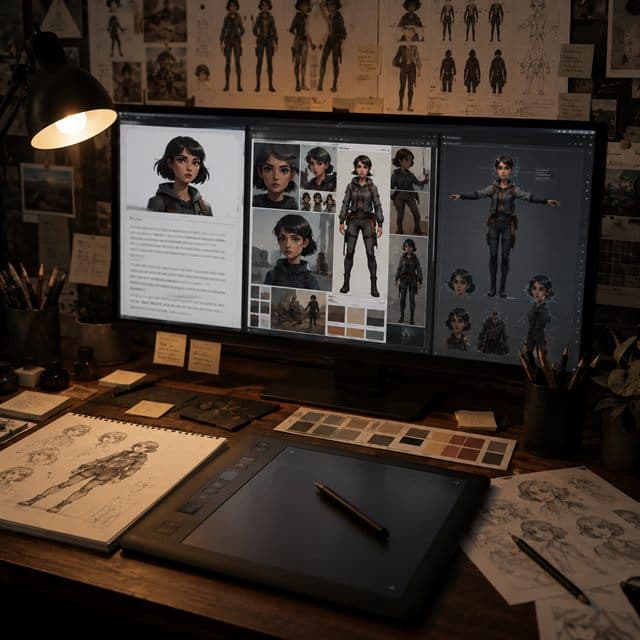
Reference images give the model something concrete. A good reference tells the AI what the face, outfit, colors, and proportions should look like. This is stronger than repeating a long prompt because the model can see the design instead of guessing from words.
Reference images are especially useful for comics, storyboards, mascots, and keyframes. They help preserve identity while the scene changes.
The limit is coverage. One front portrait may not explain the side profile, back view, or action poses. That is why a full AI character reference sheet is more useful than a single image.
The AI character sheet prompt guide includes multi-angle templates for turning one approved design into that stronger reference.
LoRA: Powerful, But Heavy
LoRA training can be effective when you have enough images, technical comfort, and time. It gives the model a learned concept of the character. For advanced Stable Diffusion users, it can be a strong option.
But LoRA is not always practical. You need a dataset, training settings, model compatibility, and maintenance. If the character changes outfit or style, you may need to retrain or tune again. For creators who just want a reusable character, that overhead can slow the project down.
This is why many users look for a Stable Diffusion character consistency alternative that does not require training.
When prompts are enough for the project, start with a fixed identity block and use these consistent character prompt templates for new scenes, angles, and poses.
The Practical Recommendation
Use prompts for exploration. Use reference images for production. Use LoRA only when you need deep technical control and have the time to maintain it.
For most creators, the best workflow is simpler:
- Generate or upload a strong base character.
- Create a multi-angle reference sheet.
- Save the character identity.
- Reuse it across scenes, panels, and video frames.
Before production, compare the result against the character reference sheet checklist so profile, proportions, colors, and asymmetrical details do not drift unnoticed.
That is the workflow Consistent Character AI is built for. It gives you the benefits of visual memory without forcing every creator to become a model trainer.